Chinese Pith Painting Lady Raising Blind Canton Export Gouache Framed Antique
Chinese Pith Painting Lady Raising Blind Canton Export Gouache Framed Antique
Couldn't load pickup availability
CHINESE PITH PAPER PAINTING OF A LADY RAISING A BAMBOO BLIND, CANTON EXPORT
Era: 19th Century (attributed)
Maker: Canton (Guangzhou) export workshops, China — unsigned
Style: Gouache on pith paper, China Trade export art
OVERVIEW:
A small Canton export painting in gouache on pith paper: a lady in a coral-pink robe patterned with blue floral sprigs, her wide sleeves banded in blue, raising a green bamboo blind and looking up at it — a charming, intimate subject of a kind the Canton studios painted by the thousand for Western visitors. It survives in a worn gilt frame with a silk mat. Sold as found, with the condition notes below read carefully.
SPECIFICATIONS:
• Framed dimensions: 6.5 x 5.35 x 0.5 inches
• Medium: Gouache (watercolor) on pith paper
• Subject: Lady raising a green bamboo window blind
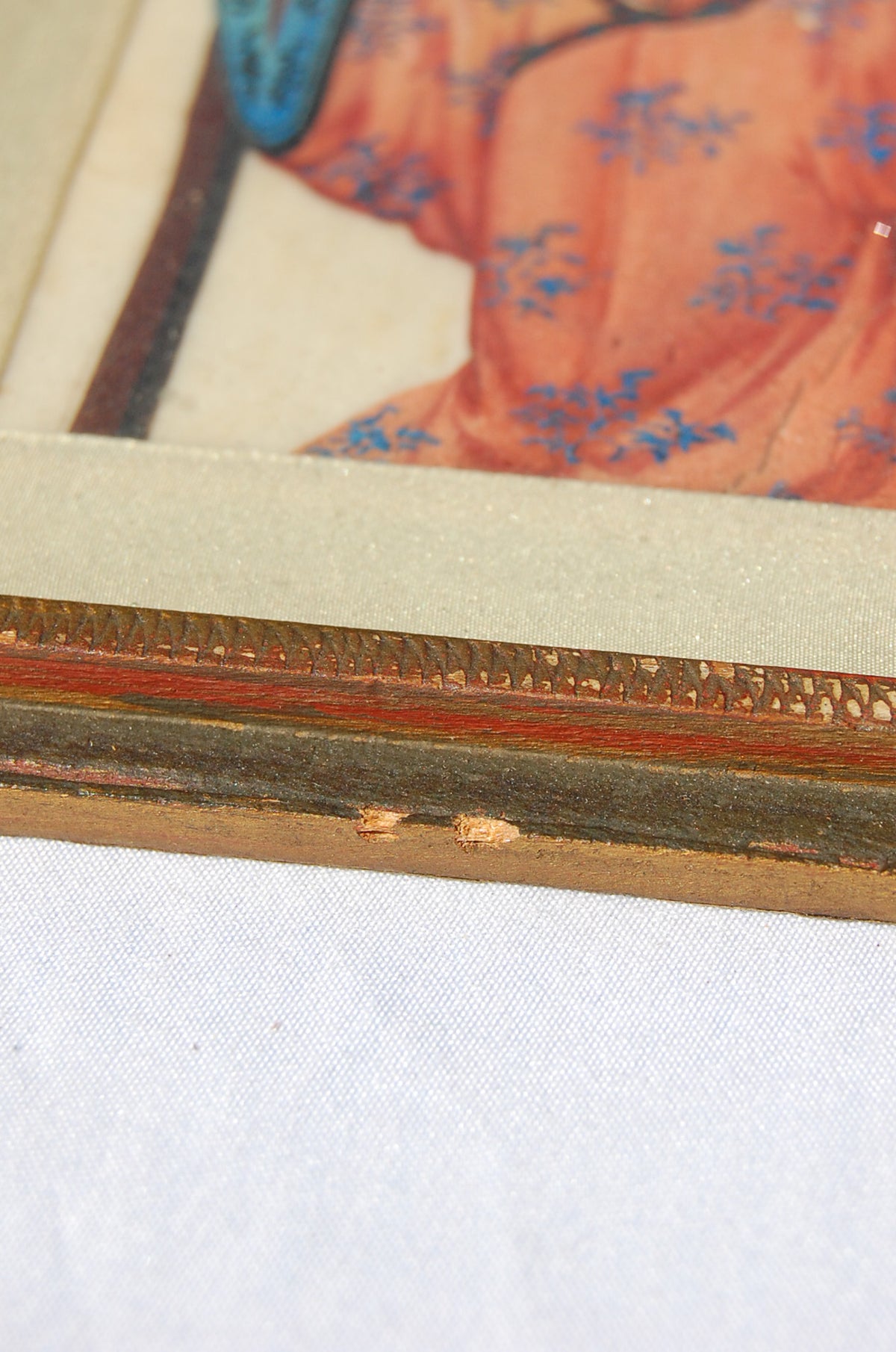
• Frame: Gilt wood frame with silk mat, later sawtooth hanger
• Origin: Canton, China (attributed)
CONDITION:
As Found — Crack Disclosed
• A prominent vertical crack runs down the center of the pith sheet, passing through the figure's face, with further fine cracks at the lower right edge — the characteristic fragility of pith paper, shown clearly in the close-up photos
• Colors remain bright; the painting is complete and legible
• Frame with gilt losses, small chips, and visible later glue repairs at the upper right corner; backing worn and partially torn
• Priced for the damage; please study the photos
HISTORICAL SIGNIFICANCE:
Pith paintings were Canton's most delicate souvenir. The "paper" is not paper at all but thin sheets shaved from the pith of the Tetrapanax plant, which takes gouache with a luminous, almost three-dimensional brightness no true paper matches. From the 1820s to the end of the 19th century, Canton studios produced them in albums and singly — mandarins, beauties, trades, tea production — for the foreign trade. The same fragility that gives them their glow means few survive uncracked, and survivors are collected as documents of the China Trade.
Share